
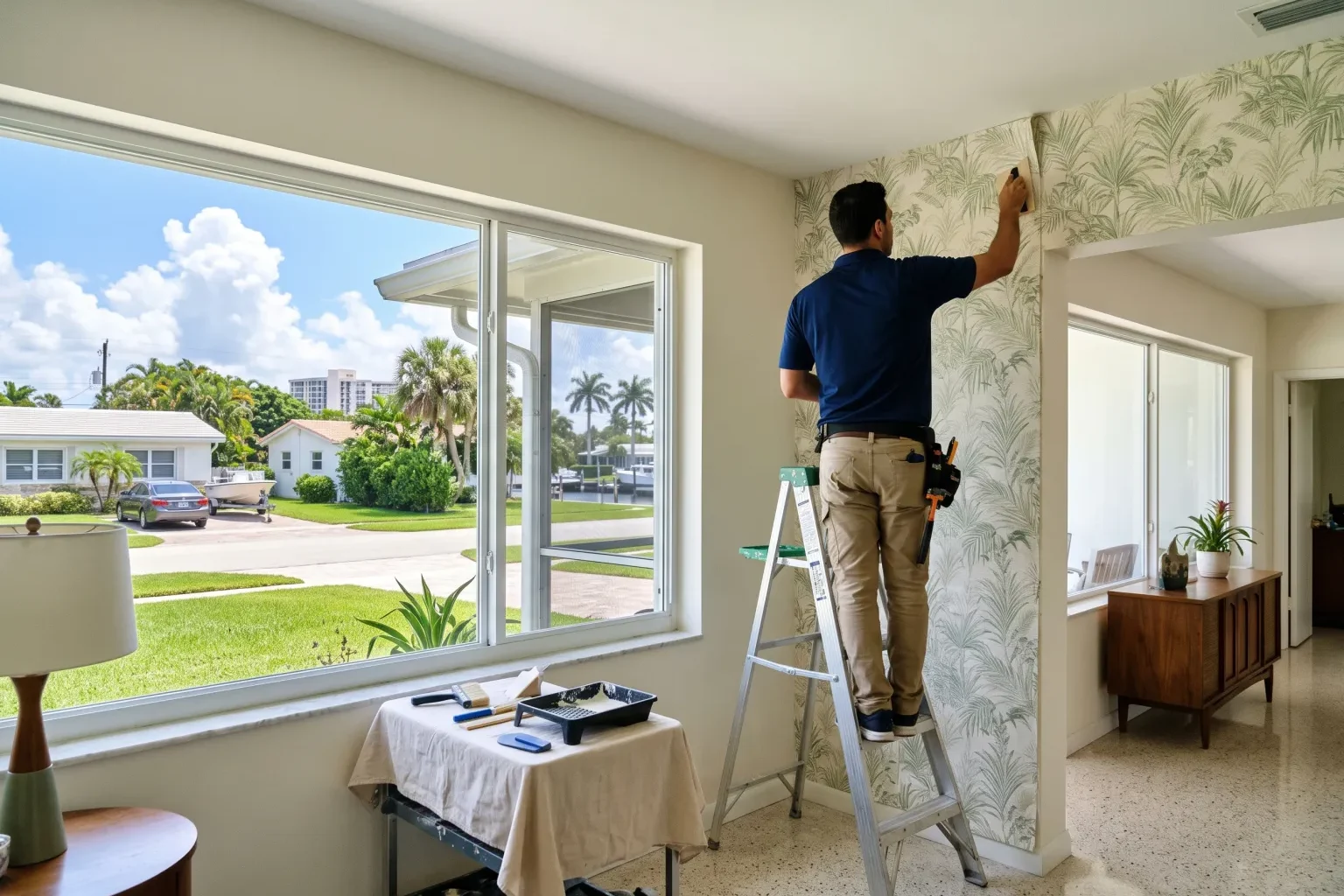
The short answer
Wallpaper is a good choice for rooms where you want lasting pattern or texture and moisture is under control. We remove old paper, repair and prime the walls, then measure, match the pattern, butt the seams, and trim every edge cleanly. Cost depends on wall condition, paper type, pattern repeat, room size, and ceiling height.
Wallpaper can give a room pattern, texture, and color that paint alone can't. It also asks more of the walls and the installer. Surfaces have to be smooth and sealed, patterns have to line up across every seam, and the paper has to be trimmed cleanly at ceilings, baseboards, and outlets. We install wallpaper for homeowners in Pompano Beach and nearby cities, from a single accent wall to full rooms and stairwells. This page explains when wallpaper makes sense, how we prepare walls, how installation works, what drives the cost, and how to keep your walls looking good.
When Wallpaper Is the Right Choice for a Room
Wallpaper is a good fit when you want a room to have a defined look that stays put. Bedrooms, dining rooms, home offices, entryways, and powder rooms are common choices. They get moderate wear and benefit from a strong visual focus. An accent wall behind a bed or sofa is an easy way to try a bold pattern without committing to an entire room.
Wallpaper is a weaker fit for spaces that stay wet for long stretches, like walls right next to a shower without good ventilation. In those rooms we usually recommend one of these options: - vinyl or another moisture-resistant paper - a working exhaust fan - a different finish altogether In South Florida, May through October is hot, humid, and wet. How a room handles moisture matters as much as the pattern you pick.
- Accent walls in living rooms and bedrooms
- Powder rooms and half baths with a working exhaust fan
- Dining rooms, entryways, and hallways
- Home offices and nurseries
- Ceilings, for a finished, layered look
How We Prepare and Prime the Walls
Most of what makes wallpaper look right happens before the first strip goes up. We start by checking the walls for cracks, nail holes, peeling paint, old adhesive, gloss level, and any sign of moisture. If old wallpaper is still on the wall, we remove it and wash off leftover paste, since new paper won't bond well over residue.
Next we patch and sand. We fill dents and holes. Textured walls may need a skim coat to create a smooth surface, because texture shows through most papers. Once the surface is flat and clean, we apply a wallpaper primer. Primer evens out how the wall absorbs adhesive and helps the paper grip. It also makes future removal much easier, because the paper can come off without tearing the drywall.
Indoor conditions matter during prep and installation. Paste and primer need time to dry, and very humid air slows that down. Ideally, the air conditioning runs steadily for a day or two before and during the job. That keeps the room at a normal, stable temperature and humidity.
Our Installation Process, Step by Step
With the walls ready, installation follows a careful sequence. Rushing any step tends to show up later as visible seams or a pattern that drifts across the room.
Some materials vary in color between strips by nature, such as grasscloth and other natural fibers. We'll walk you through what to expect with those materials before we start, so the finished look isn't a surprise.
- Measuring: We measure each wall and note windows, doors, and built-ins. Then we calculate how many rolls are needed, including the pattern repeat and extra for trimming.
- Planning the layout: We place the first strip where a mismatch would be least noticeable, such as a door corner. We also plan so the pattern centers on focal points like a fireplace or bed wall.
- Establishing plumb: Walls and corners are rarely perfectly straight, so we mark a level vertical line for the first strip instead of following the corner.
- Pasting and booking: Depending on the product, we paste the wall or the paper, or activate pre-pasted paper. Then we let it relax for the time the manufacturer specifies.
- Pattern matching: We align each strip to the one before it, whether the design is a straight match, a drop match, or a random match.
- Seams: We butt seams tightly, roll them lightly, and wipe away excess paste so edges sit flat without overlaps or gaps.
- Trimming: We trim the paper with a sharp blade and straightedge at the ceiling, baseboard, and window and door casings. Around outlets and switches, we work with the power off and cover plates removed.
- Final check: We inspect the room in both natural and artificial light, clean the surfaces, and reinstall cover plates.
What Affects the Cost of Wallpaper Installation
We quote every wallpaper job after seeing the room, because a few factors make a big difference in labor and materials.
If you haven't chosen a paper yet, we can talk through how different options would affect the work in your space.
- Wall condition: Walls that need old paper removed, repairs, or a skim coat take more time before installation can begin.
- Paper type: Vinyl, non-woven, traditional paper, grasscloth, and specialty papers each handle differently. Delicate or unpasted materials take longer to hang cleanly.
- Pattern repeat: Large repeats and drop matches use more paper and need more careful cutting than small or random patterns.
- Room size and ceiling height: More wall area means more material and time. Tall walls, stairwells, and vaulted ceilings need extra equipment and setup.
- Room complexity: Many windows, doors, outlets, built-ins, or angled walls add cuts and trimming time.
How to Care for Your Finished Walls
Wallpaper holds up well with simple care. For the first few days after installation, give the paste time to cure. Avoid washing the walls, hanging things on them, or pushing furniture against them.
After that, dust now and then with a soft cloth or a vacuum brush attachment. Many vinyl and washable papers can be wiped with a damp sponge and mild soap. Check the label for your product and test a small hidden spot first. Avoid abrasive cleaners, and don't scrub natural-fiber papers, which can stain or fray.
Moisture is the main thing to watch in our area: - Run bathroom fans during and after showers. - Keep the air conditioning on during the humid months. - Fix leaks quickly. - If you close up your home during hurricane season (June 1 to November 30), keep some climate control running so humidity doesn't build up indoors. If you notice a seam lifting, contact us early. Small lifts are much easier to fix before they spread.
Wallpaper Installation by city
- Wallpaper Installation in Lighthouse Point
- Wallpaper Installation in Hillsboro Beach
- Wallpaper Installation in Deerfield Beach
- Wallpaper Installation in Coconut Creek
- Wallpaper Installation in Lauderdale-by-the-Sea
- Wallpaper Installation in Margate
- Wallpaper Installation in Oakland Park
- Wallpaper Installation in Boca Raton
- Wallpaper Installation in Wilton Manors
- Wallpaper Installation in North Lauderdale
- Wallpaper Installation in Lauderdale Lakes
- Wallpaper Installation in Fort Lauderdale